
As laser ranging technology continues to advance, 905nm and 1535nm have become two important wavelength options in the industry. Both technologies are widely used in applications such as UAVs, security and surveillance systems, outdoor optical equipment, surveying, and long-range observation.
However, one question frequently arises: Since 1535nm laser rangefinders offer greater eye-safety margins and stronger long-range ranging potential, will they eventually replace 905nm technology?
The answer is no.
In practical applications, 905nm and 1535nm are not simply competing generations of technology. Instead, they represent two complementary approaches designed to meet different requirements in ranging distance, system cost, equipment size, and application performance.
The right choice ultimately depends on the specific requirements of the end application.
1. 905nm and 1535nm: Two Different Technological Approaches
A laser rangefinder measures distance by emitting a laser pulse and detecting the reflected signal from a target. The distance is calculated based on the time required for the laser pulse to travel to the target and return.
However, ranging performance is not determined by wavelength alone. It also depends on several factors, including laser output energy, receiver sensitivity, optical design, detector performance, environmental conditions, and ranging algorithms.
905nm and 1535nm technologies offer different advantages in system design.
905nm Laser Ranging Technology
905nm is a well-established near-infrared semiconductor laser technology. Its supporting ecosystem, including semiconductor laser diodes, silicon-based detectors, optical components, and driver electronics, is relatively mature.
This makes it attractive for applications requiring cost efficiency, compact integration, and scalable manufacturing.
Key advantages include:
- Mature semiconductor laser technology and supply chains
- Good potential for compact and lightweight system integration
- Relatively manageable system costs
- Suitability for equipment with strict size, weight, and power requirements
- Flexibility across various short-, medium-, and medium-to-long-range applications
These characteristics make 905nm laser ranging technology suitable for UAVs, security systems, outdoor optical equipment, and portable laser rangefinders.
1535nm Laser Ranging Technology
1535nm is an important wavelength in eye-safe laser ranging applications. Compared with 905nm, it generally provides a greater eye-safety margin when designed in accordance with applicable laser safety standards.
This advantage offers greater flexibility in designing high-energy pulse emission systems for certain long-range detection applications.
Key characteristics include:
Greater eye-safety design margins
Suitability for high-performance long-range ranging systems
Advantages in demanding long-distance detection applications
Applications requiring higher ranging performance and stringent laser safety requirements
1535nm technology is particularly suitable for advanced electro-optical systems, long-range observation, professional surveying, and other applications with demanding performance requirements.
2. Why Does 905nm Technology Remain Important?
As laser ranging technology develops, attention is often focused on maximum ranging distance and laser output performance. However, for practical end-user equipment, ranging distance is only one part of the overall performance requirements.
A laser rangefinder module intended for real-world applications must also address several important factors:
- Module size and weight
- Power consumption
- Ranging accuracy and stability
- Environmental adaptability
- System integration complexity
- Product cost and supply chain reliability
For UAV gimbals, security PTZ systems, and portable electro-optical equipment, size, weight, power consumption, and cost can directly influence product design.
With its mature component ecosystem and established engineering experience, 905nm technology offers a practical balance between ranging performance and overall system cost.
This is one of the key reasons why 905nm laser ranging continues to maintain its position in the market.
Its value is not simply in measuring distance, but in making reliable ranging capabilities easier to integrate into a wider range of intelligent devices through compact and cost-effective designs.
3. How Does 1535nm Meet High-End Long-Range Ranging Requirements?
In certain long-range ranging applications, conventional systems may face challenges such as low target reflectivity, ambient light interference, and weak return signals.
1535nm laser ranging technology provides additional design flexibility due to its eye-safety advantages.
When designed in compliance with applicable safety standards, system parameters such as pulse energy, receiving optics, and detector performance can be optimized according to target characteristics, detection distance, and operating conditions.
This can help improve long-range detection capabilities.
However, ranging distance is never determined by wavelength alone. Actual performance also depends on the complete transmitter and receiver design, as well as target size, reflectivity, atmospheric conditions, and other environmental factors.
At the same time, 1535nm systems generally require more specialized optoelectronic components, optical assemblies, and manufacturing processes, which may increase overall system costs.
Therefore, 1535nm is particularly attractive for professional applications requiring extended ranging capabilities and higher eye-safety margins, although it is not necessarily the most suitable choice for every type of device.
4. 905nm vs. 1535nm: How to Choose the Right Laser Ranging Solution?
For equipment manufacturers and system integrators, selecting a laser rangefinder module should involve more than comparing wavelengths or maximum ranging distances.
The decision should be based on the actual requirements of the end application.
|
Comparison |
905nm |
1535nm |
| Technology | Mature semiconductor laser technology | Eye-safe long-range laser technology |
| Eye safety | Requires careful laser safety evaluation | Generally offers greater eye-safety margins |
| System cost | Relatively easier to control | Generally higher |
| Integration | Suitable for compact and lightweight designs | Suitable for high-performance professional systems |
| Typical applications | UAVs, security systems, outdoor equipment | Long-range observation, professional surveying, advanced electro-optical equipment |
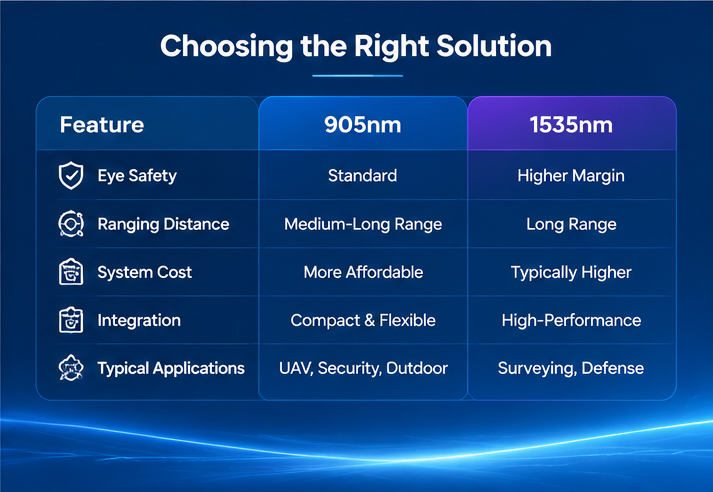
These comparisons represent general characteristics of the two technology routes. Actual ranging performance, laser safety classification, and system costs depend on individual product specifications and operating conditions.
For applications prioritizing lightweight design, cost efficiency, and large-scale deployment, 905nm may be the more practical solution.
For applications demanding extended ranging capabilities and greater eye-safety margins, 1535nm offers distinct advantages.
Neither technology is universally superior. The most appropriate solution depends on the requirements of the specific application.
5. Lumispot: Laser Ranging Solutions for Different Application Requirements
As a supplier of laser technologies and optoelectronic products, Lumispot continues to develop laser ranging solutions across different wavelength technologies, supporting customers with diverse application requirements.
905nm Laser Rangefinder Module
Lumispot’s 905nm laser rangefinder module is designed for compact ranging equipment and various optoelectronic integration applications.
It provides a ranging solution for equipment such as UAVs, security and surveillance systems, and outdoor optical devices.
Explore the product:
https://www.lumispot-tech.com/905nm-lase-rangefinder-module/
1535nm Laser Rangefinder
Lumispot’s 1535nm laser rangefinder adopts 1535nm erbium-doped glass laser technology and is designed for applications requiring extended ranging capabilities and high levels of eye safety.
The product series supports applications such as long-range observation, professional surveying, and advanced electro-optical systems.
Explore the product:
https://www.lumispot-tech.com/1535nm-laser-rangefinder/
By developing products across different wavelength technologies, Lumispot aims to provide flexible laser ranging options, helping equipment manufacturers and system integrators select solutions that best match their specific application requirements.
6.Conclusion: Complementary Technologies for Different Needs
The development of 905nm and 1535nm laser ranging technologies does not mean that one will inevitably replace the other.
With its mature technology ecosystem, compact integration potential, and cost advantages, 905nm continues to play an important role in scalable end-user applications.
Meanwhile, 1535nm offers distinct advantages in high-performance applications through its greater eye-safety design margins and long-range ranging potential.
As laser sources, detectors, optical systems, and signal processing technologies continue to advance, both technology routes are expected to evolve alongside changing application requirements.
For laser ranging systems, the most important consideration is not simply choosing the wavelength with the highest specifications, but selecting the technology that best meets the actual requirements of the task.
Lumispot remains committed to advancing laser technology and providing reliable, flexible laser ranging products and solutions for diverse applications.
Post time: Nov-19-2026


