
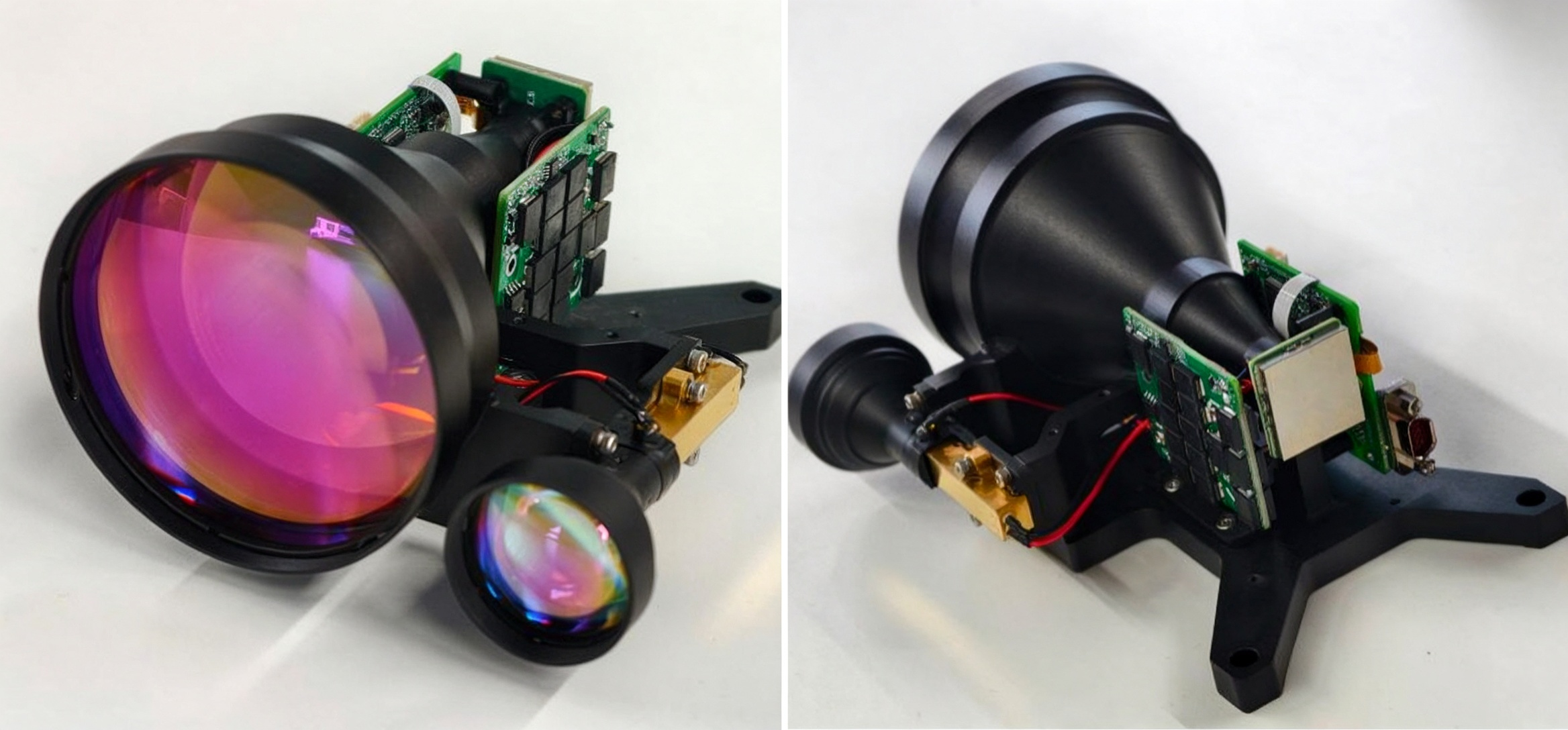
Stable Ranging of UAV Targets at Distances of Up to 3.7 km | Accuracy ≤±2 m | Class 1 Eye-Safe | One Platform for Both Long-Range Reconnaissance and Ranging
As the low-altitude economy accelerates, UAVs are evolving from aerial photography tools into a key factor in low-altitude security. Unauthorized incursions, malicious close approaches, and coordinated swarm penetration are creating new challenges for the security of airports, power stations, oil depots, border and coastal areas, and large-scale events.
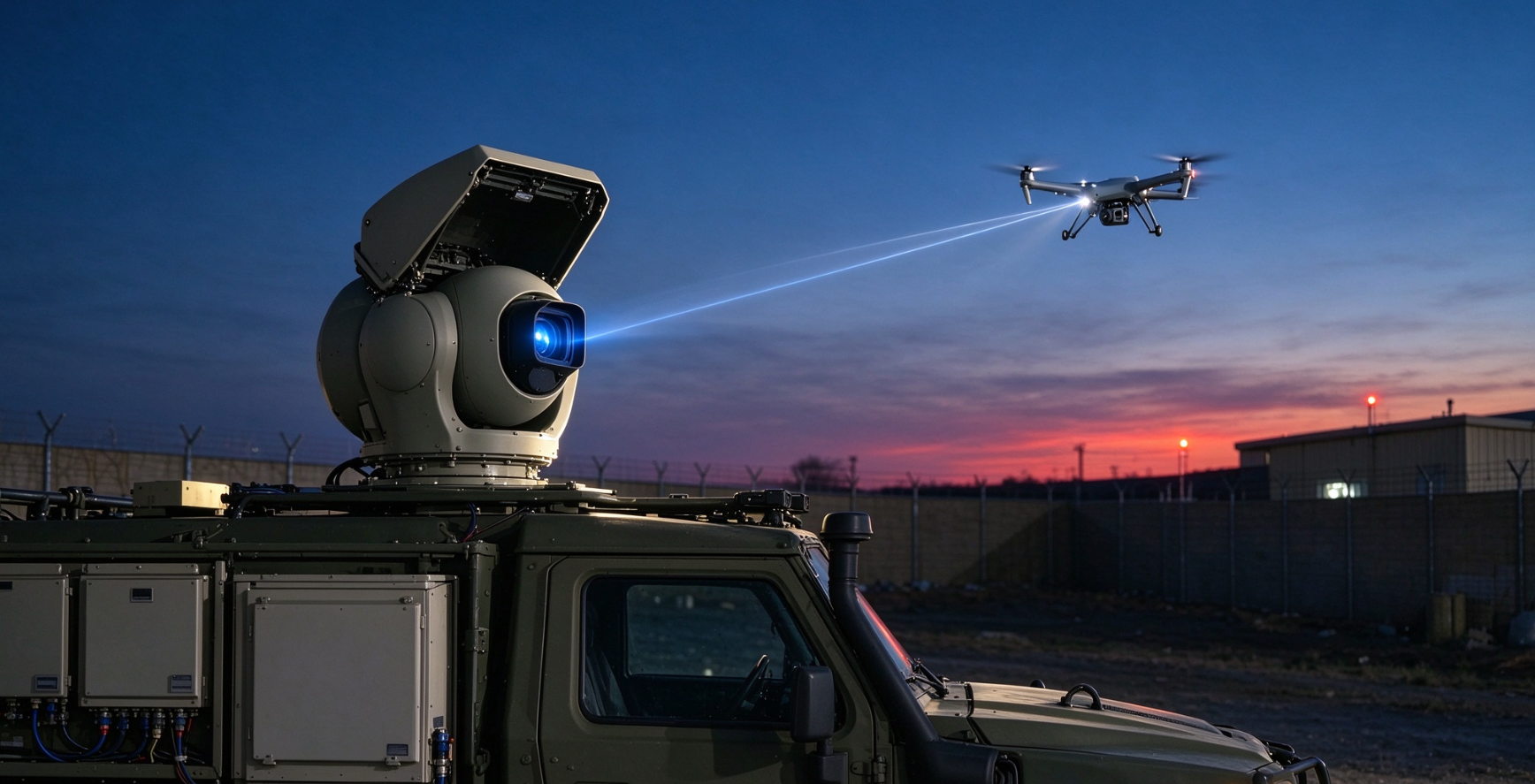
To complete the “detection–identification–tracking–response” chain, a counter-UAV system must first be able to “see” the target. Once the target is detected, laser ranging in the electro-optical system provides real-time distance data to the servo system, fire-control system, and command center. The measurement range and accuracy directly determine whether there is sufficient time for a response and whether subsequent actions can be carried out with confidence.
1. The Counter-UAV Market: You Must “See” the Target Before You Can Engage It
Low-altitude targets are typically “low, slow, and small”: they may fly at altitudes ranging from tens to hundreds of meters, have small dimensions, and follow variable flight paths. They can also use buildings, trees, and hills as background cover.
This places three key requirements on a laser rangefinder module:First, it must offer sufficient range to detect a target before it enters a threat zone.Second, it must provide accurate distance data that can be sent directly to servo and fire-control systems.Third, it must be easy to install and operate. Its compact size, low weight, low power consumption, and eye-safe operation make it suitable for installation on gimbals, deployment in urban areas, and operation in environments where people are working nearby.The 17KM Laser Rangefinder Module Series has been engineered to meet these three requirements.
2. Range: Detecting Targets Earlier Creates More Time for Response
In counter-UAV applications, range is not merely a specification to showcase; it directly translates into available response time.Taking a typical consumer UAV speed of 15–20 m/s as an example, detecting a target an additional 1 km away provides approximately 50–70 seconds more for identification, tracking, and countermeasure preparation. For applications such as airport airspace protection and the safeguarding of key facilities, where early interception is essential, this additional time can be critical.
Under standard line-of-sight conditions and typical atmospheric conditions, the 17KM Laser Rangefinder Module Series provides stable ranging performance against small UAV targets:
✅0.6 mrad narrow-beam version: Stable ranging at ≥3.7 km against a small UAV target with reference dimensions of 0.3 m × 0.2 m, and ≥2.3 km against a compact UAV target with reference dimensions of 0.1 m × 0.2 m.
✅1 mrad version: ≥3.3 km against a 0.3 m × 0.2 m small UAV target, and ≥2.1 km against a 0.1 m × 0.2 m compact UAV target.
The 0.6 mrad version concentrates the laser energy into a narrower beam, resulting in higher power density on the target at long distances. It is suitable for long-range detection and early warning.
The 1 mrad version has a wider laser spot and greater alignment tolerance, making it suitable for scenarios involving highly maneuverable targets that require dynamic tracking.
Both versions achieve detection ranges of 3 km or more against small UAV targets. For customers, this means that stable ranging data can already be obtained while the target is still outside the threat zone, so identification and response do not have to chase the target.
3. Accuracy: Accurate Measurements Enable Confident Guidance and Response
Response actions in a counter-UAV system rely on trustworthy distance measurements.
Large range deviations can cause servo guidance to oscillate and make electro-optical tracking more likely to lose the target. Frequent false alarms can also make the command center hesitant to authorize a response.
The 17KM Laser Rangefinder Module Series offers the following performance specifications:ranging accuracy: ≤±2 m,valid measurement rate: ≥98%,false alarm rate: ≤1%,distance resolution: ≤30 m,adjustable ranging frequency: 1–10 Hz.
These specifications provide four direct benefits in practical applications:
✅≤±2 m accuracy: Supports closed-loop guidance by electro-optical servo systems and fire-control calculations, helping shorten the time from detection to lock-on.
✅≥98% valid measurement rate: Provides stable data during continuous ranging, with fewer fluctuations and dropped frames, helping prevent interruptions in the tracking chain.
✅≤1% false alarm rate: Significantly reduces the probability of mistaking clouds, birds, or background reflections for targets, lowering the risk of unnecessary or incorrect responses.
✅Distance output for up to three targets + range gating: In environments with trees, buildings, or multiple UAVs in the same airspace, range gates can be used to filter echoes from nearby branches and obstacles and distinguish the UAV target of interest.
Combined with a single-pulse TOF architecture and an adjustable measurement frequency of 1–10 Hz, the module can support both stationary monitoring of key areas and continuous ranging of maneuvering targets.
For system integrators, this means that backend algorithms receive a sequence of clean, continuous, and usable distance measurements, rather than raw noise that requires extensive filtering and correction.
4. Integration and Operation: Easy to Install, Robust, and Energy-Efficient
Most counter-UAV devices are installed on electro-optical gimbals, masts, or vehicle-mounted platforms, where space, power supply, and environmental control conditions are limited.
The 17KM Laser Rangefinder Module Series has overall dimensions of ≤134 mm × 114 mm × 80 mm and weighs ≤378 g. Its standby power consumption is ≤0.2 W. Average power consumption is ≤1.5 W at 1 Hz, ≤2.5 W at 5 Hz, and ≤3.5 W at 10 Hz. With a wide input voltage range of DC 5–28 V, it can be powered directly by the platform.
The RS422 differential interface provides resistance to electromagnetic interference and is suitable for long-distance cable transmission. A complete communication protocol and host computer software are available, supporting the reading of voltage, temperature, APD status, and cumulative laser emission count to facilitate overall system health management.
In terms of environmental adaptability, the operating temperature range is -40°C to +60°C, and the storage temperature range is -55°C to +70°C. The module can withstand a shock of 75 g @ 6 ms and meets the vibration environment requirements of propeller-driven aircraft.Its 1535 nm erbium-glass laser source meets Class 1 eye-safety requirements, making it suitable for use in urban areas, densely populated locations, and operations involving multiple personnel without requiring additional laser protection. The Φ65 mm large-aperture receiver, together with multi-stage stray-light suppression—including an aperture stop, a low-scatter blackened inner surface, and 1535 nm narrowband filtering—helps block strong daylight, specular reflections from the sea surface, and out-of-field stray light before they reach the detector, maintaining echo signal-to-noise ratio under strong background-light conditions.
5. One Platform, Two Capabilities: Changing Beam Divergence Enables 17 km Vehicle Ranging
Based on the 17KM Laser Rangefinder Module Series, a derivative ranging model has been developed for large targets, vehicles, and people.It uses the same 1535 nm erbium-glass laser source, the same Φ65 mm large-aperture receiver, and the same stray-light suppression architecture. By changing the beam divergence from 0.6 mrad/1 mrad to 0.3 mrad, the platform can be configured for long-range reconnaissance:≥17 km for a standard vehicle target measuring 2.3 m × 4.6 m, ≥20 km for a large vehicle measuring 4 m × 6 m, ≥20 km for large building targets.
The practical benefit for customers is that low-altitude counter-UAV applications and long-range reconnaissance can use laser rangefinder modules from the same product series.
The module installation envelope, mounting-hole positions, wiring definitions, and communication protocols are fully consistent. Users only need to select and install the appropriate model with the required beam configuration, without maintaining two independent product lines.
This helps reduce procurement, spare-parts, maintenance, and training costs.
For users of border and coastal surveillance systems, key-site protection systems, and vehicle-mounted electro-optical gimbals that need to monitor both low-altitude targets and distant objects, this “one platform, multiple models, configuration on demand” approach offers greater engineering value than focusing on a single specification.
Key Performance Specifications
|
No. |
Parameter |
0.6 mrad Version |
1 mrad Version |
0.3 mrad Version |
|
1 |
Eye-safety class |
Class1 |
||
|
2 |
Laser wavelength |
1535±5nm |
||
|
3 |
Laser beam divergence |
0.6mrad±0.2mrad |
1mrad±0.2mrad |
≤0.3mrad |
|
4 |
Receiver aperture |
Φ65mm |
||
|
5 |
Maximum range (visibility ≥20 km) |
≥20 km (large target: building) |
||
|
6 |
≥3.7 km (small UAV target: 0.3 m × 0.2 m) |
≥3.3 km (small UAV target: 0.3 m × 0.2 m) |
≥20 km (vehicle: 4 m × 6 m) |
|
|
7 |
≥2.3 km (compact UAV target: 0.1 m × 0.2 m) |
≥2.1 km (compact UAV target: 0.1 m × 0.2 m) |
≥17 km (vehicle: 2.3 m × 4.6 m) |
|
|
8 |
/ |
/ |
≥10.5 km (person: 1.7 m × 0.5 m) |
|
|
9 |
Minimum range |
≤100m |
||
|
10 |
Ranging accuracy |
≤±2m |
||
|
11 |
Measurement frequency |
1~10Hz |
||
|
12 |
Distance resolution |
≤30m |
||
|
13 |
Valid measurement rate |
≥98% |
||
|
14 |
False alarm rate |
≤1% |
||
|
15 |
Data interface |
RS422 serial port |
||
|
16 |
Input voltage |
DC5~28V |
||
|
17 |
Average power consumption |
≤1.5W@1Hz;≤2.5W@5Hz;≤3.5W@10Hz |
||
|
18 |
Peak power consumption |
≤6W |
||
|
19 |
Standby power consumption |
≤0.2W |
||
|
20 |
Dimensions |
≤134mm×114mm×80mm |
||
|
21 |
Weight |
≤378g |
||
|
22 |
Operating temperature |
-40℃~+60℃ |
||
|
23 |
Storage temperature |
-55℃~+70℃ |
||
|
24 |
Shock |
75g@6ms |
||
|
25 |
Vibration |
Propeller-driven aircraft vibration environment |
||
Conclusion
Low-altitude defense is not determined by a single specification, but by a system-level capability to detect early, maintain tracking, measure accurately, and integrate easily. The 17KM Laser Rangefinder Module Series is built on stable ranging of small UAV targets at distances of 3 km or more, accuracy of ≤±2 m, and Class 1 eye-safe operation. The 0.6 mrad and 1 mrad models address the respective requirements of long-range early warning and dynamic tracking. When long-range reconnaissance is required, switching to the 0.3 mrad version enables ranging of standard vehicle targets at distances of 17 km or more. With multiple models compatible on the same platform, the series provides a practical, scalable ranging core for counter-UAV systems and long-range electro-optical sensing.
Disclaimer: Export bundled with UAV platforms is subject to relevant national export control regulations.
Post time: Nov-27-2026


