
As industrial automation and smart manufacturing continue to evolve, machine vision has become an important technology in industrial inspection. From component measurement and surface defect detection to railway inspection and logistics volume measurement, optical inspection technologies are increasingly being adopted to improve inspection efficiency and measurement consistency.
Among these technologies, structured light lasers play an important role.
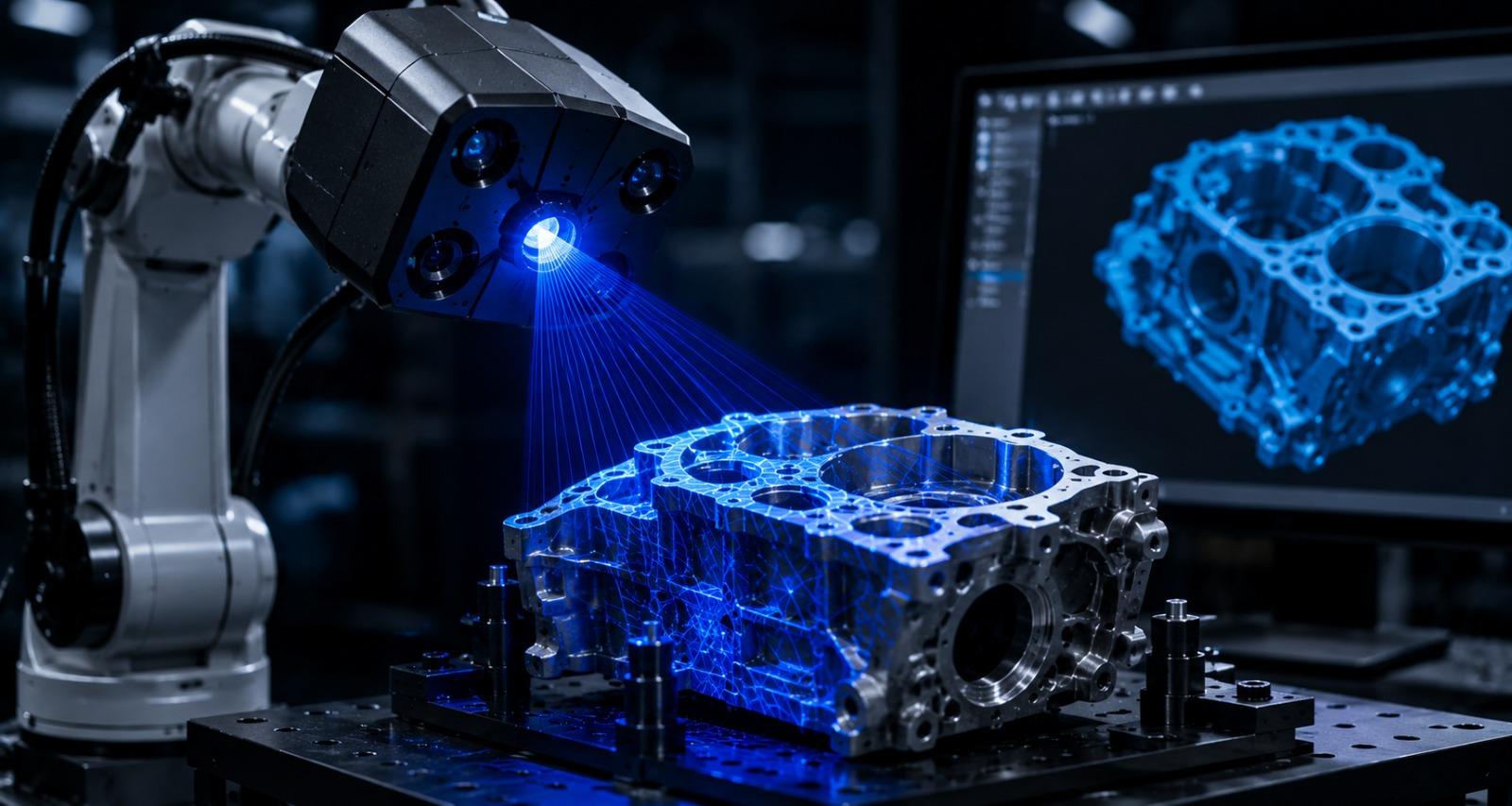
By projecting laser patterns with specific geometric characteristics onto an object’s surface and capturing the resulting images with industrial cameras, machine vision systems can obtain surface profile information for 3D reconstruction, dimensional measurement, and automated inspection.
But how does structured light technology work? And why are laser line uniformity, stability, and optical design important to inspection performance?
1. What Is Structured Light Laser Technology?
Structured light is an active optical measurement technique. It works by projecting a predefined light pattern onto an object and capturing how that pattern changes across the object’s surface.
When a laser line is projected onto surfaces with different heights, angles, and shapes, its geometric profile changes accordingly. By analyzing these variations and combining them with camera calibration and geometric calculations, a machine vision system can reconstruct three-dimensional surface profiles.
Compared with inspection methods relying solely on conventional images, structured light provides additional depth and surface geometry information, making it useful for 3D measurement and complex surface inspection.
In practical applications, the structured light source, industrial camera, image processing algorithms, and motion platform typically work together as an integrated inspection system.
2. Why Is Laser Line Uniformity Important?
The optical output quality of a structured light source can directly influence image acquisition and subsequent data processing.
Two important factors are laser line uniformity and line width consistency.
Laser Line Uniformity
Significant brightness variations along a laser line may cause certain areas of the captured image to appear excessively bright or dark. This can make image processing and feature extraction more challenging.
A uniform laser line helps improve image consistency and provides more stable optical input for profile extraction and 3D reconstruction.
Line Width Consistency
Line width stability is also important in precision inspection applications. Variations in line width may affect feature positioning and profile calculations.
Therefore, appropriate optical parameters should be selected according to working distance, measurement requirements, and target surface characteristics.
Other factors, including illumination angle, output power, ambient light interference, and operating temperature, should also be considered during system design.
3. Single-Line vs. Multi-Line Structured Light: What Is the Difference?
Depending on inspection speed, field of view, and data acquisition requirements, structured light systems can use either single-line or multi-line laser sources.
Single-Line Structured Light Laser
A single-line structured light source projects one laser line onto an object’s surface to capture its profile information.
When relative movement occurs between the object and the scanning system, successive profile measurements can be collected and combined to reconstruct the object’s three-dimensional geometry.
Key characteristics include:
- Relatively straightforward optical configuration
- Suitable for continuous profile scanning
- Adjustable output power and illumination angle
- Applicable to various industrial inspection and 3D reconstruction tasks
Multi-Line Structured Light Laser
A multi-line structured light source projects multiple laser lines simultaneously, providing additional optical features for image acquisition.
With suitable system configurations and scanning conditions, multi-line solutions can support high-speed 3D scanning applications and provide additional flexibility for rapid inspection processes.
Key characteristics include:
- Simultaneous projection of multiple laser lines
- Support for high-speed motion 3D scanning applications
- Consistent line width and high parallelism as important design considerations
- Customizable line numbers and illumination angles
Neither configuration is universally superior. The selection depends on inspection speed, system architecture, scanning methods, data processing capabilities, and the requirements of the final application.
4. Industrial Applications of Structured Light Lasers
As demand for automated inspection continues to grow, structured light laser technology is being adopted across various industrial sectors.
3D Reconstruction and Industrial Dimensional Inspection
In manufacturing, structured light helps inspection systems capture three-dimensional component profiles for dimensional measurement, shape analysis, and assembly quality inspection.
By processing the acquired data, systems can identify geometric features and provide useful information for automated quality control.
Railway Track and Wheelset Inspection
Railway equipment operates under continuous mechanical loads and changing environmental conditions. Line lasers combined with machine vision systems can capture the profiles of railway tracks, wheels, and related components for inspection and condition monitoring.
Structured light solutions can also be applied to vehicle and pantograph inspection, providing optical data to support railway infrastructure and rolling stock monitoring.
Road Surface Inspection
Through laser line scanning and image analysis, inspection systems can acquire road surface profile information for pavement condition analysis and related inspection tasks.
Logistics Volume Measurement
In automated logistics applications, structured light systems can scan object surfaces to obtain three-dimensional profile data. This information can help calculate package dimensions and cargo volume, supporting automated sorting and warehouse management.
5. Lumispot Structured Light Laser Solutions
To address different requirements in industrial machine vision and automated inspection, Lumispot has developed single-line and multi-line structured light laser sources for applications including 3D reconstruction, industrial inspection, and railway and road detection.
Single-Line Laser Light Source
Lumispot’s single-line structured light laser source offers 808nm and 915nm wavelength configurations, with an output power range of 5W–18W.
Key features include:
- Compact design
- Uniform output laser line
- Adjustable laser output power
- Stable operation across a wide temperature range
- Multiple illumination angle configurations and customization options
Depending on the model, the product supports line widths of 0.5–2.0mm and various illumination angles.
Typical applications include 3D reconstruction, industrial inspection, road surface detection, logistics volume measurement, and railway inspection.
Explore the product:
https://www.lumispot-tech.com/single-laser-line-light-source-product/
Multi-Line Laser Light Source
For high-speed motion 3D scanning and multi-line inspection requirements, Lumispot offers an 808nm multi-line structured light laser source with an output power range of 5W–15W.
Key features include:
- Compact design
- Uniform laser line output
- Support for high-speed motion 3D scanning
- Consistent line width and high parallelism
- Customizable laser line numbers and illumination angles
The product supports three-line and multi-line configurations and can be used in 3D reconstruction, railway wheelset and track inspection, road surface detection, logistics volume measurement, and industrial inspection.
Explore the product:
https://www.lumispot-tech.com/multi-laser-line-light-source-product/
Through its range of structured light solutions, Lumispot provides optical light source options for equipment manufacturers and system integrators, helping address different requirements in scanning methods, optical parameters, and operating environments.
Conclusion
As industrial machine vision continues to evolve toward 3D inspection, higher scanning speeds, and greater automation, structured light laser sources are becoming increasingly important components of modern inspection systems.
From laser line uniformity and output stability to the selection of single-line or multi-line configurations, every aspect of optical design can influence the final inspection results.
Lumispot remains committed to advancing structured light laser technology and providing reliable laser light source products and solutions for industrial machine vision, 3D reconstruction, railway inspection, and automated inspection applications.
Post time: Nov-20-2026


