
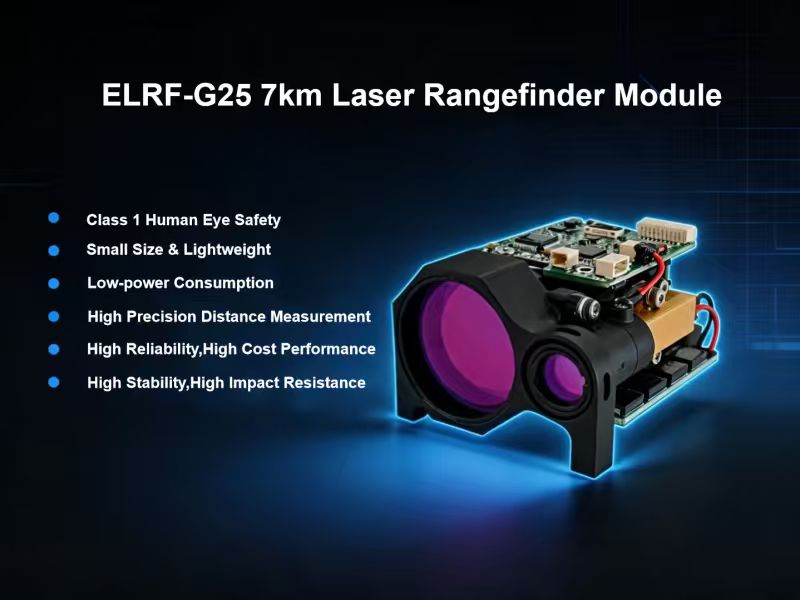
Lumispot today announced the general availability of its ELRF-G25 laser rangefinder module as a stocked, off-the-shelf product. Previously offered as a customized variant of the company’s established 8km LRF platform, the ELRF-G25 is now ready for immediate shipment, delivering 7-kilometer vehicle-target ranging performance in a compact 72-gram form factor.
Built on Lumispot’s in-house developed 1535nm erbium-glass laser technology, the ELRF-G25 employs single-pulse time-of-flight (TOF) ranging architecture. The module integrates a laser emitter, transmitting optics, receiving optics, and a control circuit board into a single unit, communicating with a host system via an RS422 serial interface. Lumispot provides companion host-side test software and a full communication protocol, enabling straightforward secondary development and integration.
Core Ranging Performance
Under standard conditions of ≥20 km visibility and ≤80% humidity, the ELRF-G25 delivers the following ranging capabilities:
- • Large targets (buildings): ≥8 km
- • Vehicle targets (2.3 m × 2.3 m, diffuse reflectance ≥0.3): ≥7 km
- • Personnel targets (1.75 m × 0.5 m, diffuse reflectance ≥0.3): ≥5 km
The module supports both single-shot and continuous ranging modes, multi-target detection, range gating, and a built-in self-test function. Ranging accuracy is rated at ≤±1 m, with a measurement frequency adjustable from 1 to 10 Hz and a minimum measurable distance of ≤30 m.
Key Technical Specifications
The ELRF-G25 operates at a wavelength of 1535 ± 5 nm with Class 1 eye safety, making it suitable for field deployment where operator safety is a priority. The beam divergence is ≤0.3 mrad, paired with a Φ25 mm receiving aperture.
| Parameter | Specification |
| Wavelength | 1535 ± 5 nm |
| Eye-safety | Class 1 |
| Beam divergence | ≤0.3 mrad |
| Receiving aperture | Φ25 mm |
| Ranging accuracy | ≤±1 m |
| Measurement frequency | 1–10 Hz |
| Data interface | RS422 serial (115200 bps) |
| Supply voltage | DC 5–28 V |
| Average power | ≤1 W @ 5 V (1 Hz) |
| Peak power | ≤4 W @ 5 V |
| Dimensions | ≤65 × 46 × 32 mm |
| Weight | ≤72 g |
| Operating temperature | –40 °C to +60 °C |
| Shock resistance | >75 g @ 6 ms |
The module’s electrical interface uses an A1002WR-S-10P connector with ten pins covering power, RS422 communication, CAN bus, and ground. Power consumption is exceptionally low—under 1 watt at 1 Hz operation—making the ELRF-G25 well-suited for battery-powered and portable systems.
From Custom Variant to Stocked Product
Originally developed as a customized configuration of Lumispot’s 8km-class rangefinder platform, the ELRF-G25 has seen sustained customer demand that justified moving it into standard production inventory. The transition means integrators can now source the 7 km module with the same lead-time advantages and supply reliability as Lumispot’s flagship 8 km variant, without the wait and engineering overhead of a custom build.
The module retains the full environmental qualification of its parent platform, including an operating temperature range from –40 °C to +60 °C and shock resistance exceeding 75 g at 6 ms (with a 1000 g / 1 ms option available for custom orders). It is rated for the combined vibration environment of wheeled vehicles, ensuring robust performance in mobile and mounted applications.
Target Applications
The ELRF-G25 is designed for integration into a wide range of optoelectronic systems, including:
- • Handheld rangefinders and observation devices
- • Vehicle-mounted electro-optical systems
- • UAV / drone payloads and pod systems
- • Surveillance and border security equipment
- • Forestry, geological survey, and industrial measurement instruments
Its small footprint, light weight, and low power profile make it particularly attractive for weight- and power-constrained platforms where long-range detection is still required.
Availability and Support
The ELRF-G25 laser rangefinder module is now in stock and available for immediate order. Lumispot provides comprehensive integration support, including host test software, communication protocol documentation, and application engineering assistance for custom mechanical or optical integration requirements.
Post time: Aug-07-2026


