
Introduction
In the fields of controlled nuclear fusion plasma diagnostics, attosecond ultrafast optics, aerospace photoelectric detection, high-energy intense laser physics, and cutting-edge precision scientific research, 1064 nm near-infrared Nd:YAG pulsed lasers—leveraging mature optical path infrastructure, excellent electro-optical conversion efficiency, and high-repetition-rate pulse output characteristics—have become the core benchmark light source for demanding experimental scenarios such as high-frequency continuous detection, ultrafast dynamic process capture, and long-term stable optical path operation. The spatial energy distribution of the laser beam directly determines the system detection signal-to-noise ratio, experimental data reproducibility, and optical coupling precision. Among these, plateau uniformity, as the core technical metric quantifying the uniformity of spatial energy distribution, is the key factor limiting the performance ceiling of high-end solid-state lasers under high-frequency operating conditions.
Product Overview
The Nd:YAG semiconductor side-pump laser gain module, independently developed by Lumispot, features specialized structural and optical path optimizations targeting industry pain points such as poor beam uniformity and long-term beam degradation in high-frequency scientific applications. The product adopts a circumferential side-pump layout, optimizing pump energy distribution from the crystal gain end, and is paired with a proprietary high-precision fully closed-loop water-cooling system to efficiently dissipate accumulated heat under 1 kHz high-frequency operating conditions, suppressing negative effects such as thermal lens distortion and thermal depolarization.
Comprehensive system testing confirms that the global beam plateau uniformity of this module remains stably above 90%, effectively improving issues such as beam energy imbalance and pulse energy fluctuation, ensuring long-term stability and reliability of beam quality. It provides a highly reliable and reproducible domestic laser gain solution for cutting-edge optical research, filling the technical gap in high-uniformity high-repetition-rate laser devices and supporting the autonomous development of high-end optoelectronic core components.
Core Significance of Plateau Uniformity
Standard Definition
Standard Number: ISO 13694-3.2.11
English Name: plateau uniformity
Chinese Name: 平顶均匀度
Symbol: U~p~(z)
Standard Definition: Quantitative measure for the homogeneity of nearly flat-top profiles
Chinese Interpretation: Quantitative indicator for the homogeneity of approximately flat-top beam profiles
Plateau Uniformity Formula
Parameter Definitions
Where ΔEFWHM[ΔHFWHM] is the full−width at half−maximum(FWHM)of the peak near Emax[Hmax]of the power (energy) density histogram N(Ei)[N(Hi)], i.e. the number of (x,y) locations at which a given power (energy) density Ei[Hi] is recorded.
Note 1 to entry: 0<Up(z)<1; Up(z)→0 as distributions become more flat-topped.
Domestic Industry Standard Conversion Formula
The original ISO standard value U~p~(z) lacks intuitive clarity. The domestic laser testing and beam profiling industry has uniformly adopted uniformity qualification rate for intuitive evaluation, adapted for engineering acceptance, equipment factory inspection, and process calibration scenarios:
Conversion Formula: Uniformity Qualification Rate = (1 − U~p~(z)) × 100%
Evaluation Logic:
- The higher the uniformity qualification rate percentage, the better the beam plateau uniformity;
- A higher qualification rate indicates a larger proportion of effective uniform irradiation area within the beam spot and fewer invalid fluctuation regions;
- Example: U~p~(z) = 0.05 corresponds to a uniformity qualification rate of 95%, representing a high-quality flat-top beam; U~p~(z) = 0.2 corresponds to 80%, indicating poor beam plateau flatness.
Fundamental Physical Significance
Laser beam spots are classified into two categories: Gaussian beams and flat-top beams. Gaussian beams exhibit extremely high central energy with rapid edge energy decay, making large-area uniform irradiation impossible. In contrast, the core requirement of flat-top beams is that the energy/power within the large central area of the spot remains highly consistent, with only a gradual roll-off at the edges.
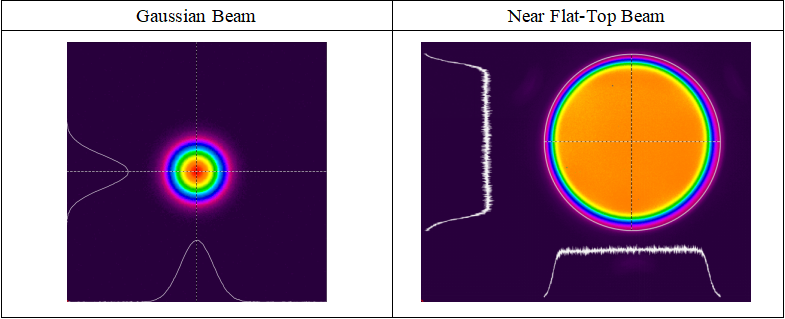
Conventional RMS uniformity primarily statistically evaluates overall beam intensity fluctuations across the entire spot and is susceptible to interference from low-energy edge regions, making it incapable of accurately assessing the flatness of the core flat region of flat-top beams. Plateau uniformity U~p~(z) is a specialized evaluation metric tailored for flat-top beams; it eliminates edge tail interference and focuses exclusively on energy fluctuations within the core plateau region of the beam spot, precisely describing the flatness of the beam’s top platform.
Product Specifications and Test Data
Product Specifications
| Category | Parameter | Unit | Value | Remarks |
| Optical | Pump Peak Power | W | ≥ 25,000 | @ 25°C |
| Pump Center Wavelength | nm | 806 ± 2 | @ 25°C | |
| Single Bar Peak Power | W | — | ||
| Number of Bars | Pcs | — | ||
| Crystal Rod Dimensions | mm | Ø15x | Nd:YAG | |
| Emitting Height | mm | 75 | — | |
| Electrical | Operating Mode | — | QCW | — |
| Threshold Current | A | — | ||
| Operating Current | A | ≤ 90 | — | |
| Operating Voltage | V | — | ||
| Duty Cycle | — | ≤ 20% | — | |
| Pulse Width | μs | ≤ 200 | — | |
| Operating Frequency | Hz | ≤ 1000 | — | |
| Other | Operating Temperature | °C | 25 ± 5 | No condensation |
| Storage Temperature | °C | 5 ~ 50 | No condensation | |
| Volume Flow Rate | L/min | |||
| Fluid Pressure | MPa | 0.25 ~ 0.4 | — |
Test Data
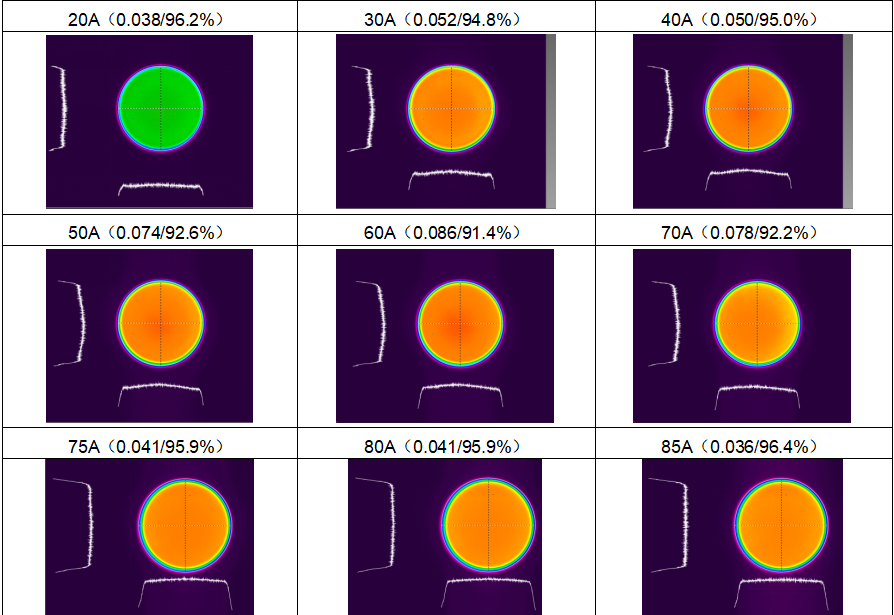
Test Conditions: 20–85 A / 200 μs / 1000 Hz / 20°C
Per ISO 13694-3.2.11 evaluation criteria, global pump uniformity satisfies < 0.1;
Per domestic uniformity evaluation criteria, global pump uniformity satisfies > 90%.
Core Product Advantages
1 kHz High-Frequency Extreme Beam Homogenization with Global Uniformity Stably Exceeding 90%
Utilizing a circumferential symmetric side-pump optical path arrangement, pump light achieves uniform axial and radial coupling within the crystal, fundamentally circumventing the inherent defects of Gaussian beams—central energy concentration and excessively rapid edge energy decay. Throughout the entire 1 kHz high-repetition-rate output process, the beam energy density distribution approaches an ideal flat-top beam with minimal spatial domain energy fluctuation and negligible pulse-to-pulse energy deviation. It perfectly matches the stringent requirements of frontier physics experiments, fusion plasma detection, and spatial optical calibration for beam spatial uniformity, pulse temporal consistency, and experimental data reproducibility, completely eliminating experimental data drift, detection signal distortion, and optical path coupling efficiency degradation caused by beam energy deviation.
High-Precision Fully Closed-Loop Water-Cooling Thermal Control for Zero Thermal Drift During Long-Term High-Frequency Operation
Equipped with a customized fully closed-loop water-cooling thermal management system, the module achieves zoned independent temperature control for core heat-generating components including the Nd:YAG laser crystal, pump bar array, and optical resonator. Faced with long-term 1 kHz high-frequency operation and high average power steady-state output, it efficiently counteracts crystal photothermal effects, comprehensively suppressing thermal lensing, thermally induced beam distortion, and gain thermal depolarization. This ensures constant beam parameters under high-frequency operating conditions, meeting the stringent requirements of high-end precision optical experiments.
Integrated Packaging with Outstanding Adaptability to Extreme Research Environments
The complete system employs integrated packaging technology, exhibiting excellent resistance to mechanical vibration, electromagnetic interference, high-energy space radiation, and wide-temperature-range environmental tolerance. It is adaptable to complex research conditions including ultra-clean optical laboratories, vacuum optical cavities, space simulation chambers, and low-temperature extreme experiment chambers. The built-in multi-stage optical back-reflection protection structure effectively protects the crystal and pump source from damage caused by reverse-reflected light in the optical path, extending the service life of core optical components and ensuring long-term stable operation of the entire laser system.
Fully Traceable Parameter Testing Aligned with National-Level Research Project Acceptance Standards
Prior to delivery, each side-pump module undergoes full-field beam scanning and sampling using a high-precision beam profiler. Plateau uniformity U~p~(z) is strictly calculated in accordance with the ISO 13694 standard, with a concurrent beam uniformity test report and original beam profile calibration curve provided. All optical parameters are traceable, and experimental data are fully reproducible, fully complying with the admission and acceptance specifications for national major scientific research projects, key laboratory optical path integration, and space optical equipment—eliminating the need for customers to conduct additional third-party beam testing and calibration.
Cutting-Edge Core Application Fields
Controlled Nuclear Fusion Devices | Tokamak Plasma Diagnostic Systems
Suitable for laser diagnostic optical paths in major tokamak plasma devices, serving as the core excitation light source for Thomson scattering diagnostics, Rayleigh scattering diagnostics, and laser interferometry diagnostic systems. Leveraging 1 kHz high repetition rate and >90% ultra-high beam uniformity, it enables millisecond-precision continuous real-time detection of plasma electron temperature, electron density, ion flow velocity, and boundary perturbation parameters inside fusion devices. The uniform, distortion-free flat-top beam effectively suppresses diagnostic optical path scattering noise, enhancing the signal-to-noise ratio of weak detection signals and ensuring the continuity and accuracy of detection data during long-term steady-state plasma operation. It provides reliable laser source support for magnetic confinement fusion mechanism research and long-pulse plasma steady-state control.
Attosecond Optics and Strong-Field Ultrafast Physics Frontier Experiments
Widely applied in frontier ultrafast optical experiments including attosecond pulse generation and characterization, high-harmonic generation, strong-field laser–atom/molecule interactions, ultrafast electron dynamics detection, and transient material structure evolution observation. The ultra-high spatial uniformity flat-top beam ensures completely consistent gain within the laser–gas target and laser–solid target interaction regions, eliminating harmonic spectral distortion and pulse temporal jitter caused by spatial beam energy perturbations. Simultaneously, the stable 1 kHz high-repetition-rate output increases the average photon flux of attosecond sources, enabling continuous acquisition and observation of high-frequency ultrafast processes, and supporting breakthrough research in strong-field physics, attosecond metrology science, and ultrafast spectroscopy.
Aerospace Space Optical Payloads and On-Board Laser Optical Path Systems
Applicable to ground-based space optical payload calibration, space vacuum environment laser simulation testing, satellite-borne laser detection sources, space target irradiation simulation, and on-orbit optical component performance testing in space optical engineering scenarios. The hermetically sealed, radiation-resistant packaging is perfectly adapted to extreme space environments including space vacuum, high-energy space radiation, and orbital high-low temperature cycling, with no beam drift or performance degradation during long-term operation. The high-frequency, high-uniformity laser output enables ground-based pre-calibration and on-orbit simulation testing of satellite-borne optical lenses, spectral detection modules, and space coherent optical paths, supporting the R&D and iterative testing of deep space exploration, space laser communication, and space target sensing projects.
High-Energy Intense Laser Amplification Systems and Laser Plasma Physics Experiments
Serves as a pre-amplification seed source for high-energy pulsed laser regenerative amplification and multi-pass amplification chains, while also being suitable for high-energy laser experiments including laser plasma interactions, laser shock peening, X-ray pump-probe detection, and laser wakefield electron acceleration. The high-uniformity flat-top seed beam effectively enhances beam quality consistency in subsequent laser amplification chains, avoiding amplified spontaneous emission (ASE) noise amplification caused by spatial beam non-uniformity. The long-term water-cooling thermal control solution satisfies the requirements for continuous amplification operation in high-energy laser systems over extended periods, ensuring long-term beam quality stability of the entire intense laser facility.
National Key Laboratory Frontier Optical Platforms
Precisely matches the optical path integration requirements of cutting-edge research institutes, domestic Double First-Class university optical key laboratories, and national major scientific research infrastructure optical experiment platforms, covering diversified high-end research scenarios including precision optical metrology, laser spectroscopic analysis, nonlinear optics research, extreme environment laser effect testing, and coherent beam combination. The product’s complete traceable beam test reports, standardized optical interfaces, and stable, reproducible optical parameters directly satisfy the admission and acceptance requirements of national major scientific research instrument development projects and key R&D program projects. It also supports modular optical path integration, reducing the difficulty of research system construction and alignment.
Product Services and Customization Support
1. Complete Traceable Testing Documentation: Each module is accompanied by an ISO-standard beam uniformity test report, factory qualification certificate, and original beam calibration curve. Documentation is complete and ready for direct use in research project finalization, equipment acceptance, and project auditing.
2. Dedicated Scientific Research Technical Support: 7×24-hour specialized optical technical liaison services are provided, with one-on-one assistance for customers throughout the entire process including optical path integration, water-cooling system matching, resonator alignment, and beam parameter optimization.
3. Specialized Customization for Research Scenarios: Customization is available based on experimental requirements for beam spot size, repetition rate range, water-cooling interface specifications, mechanical mounting dimensions, and optical coating parameters, tailored to specific experimental optical path needs.
4. Domestic Replacement for High-End Laser Sources: Core optical performance is benchmarked against imported first-tier brand side-pump laser gain modules, with shorter delivery cycles, faster localized after-sales response, and higher customization flexibility, supporting comprehensive autonomous control of domestic frontier optical research equipment.
Post time: Sep-08-2026


