
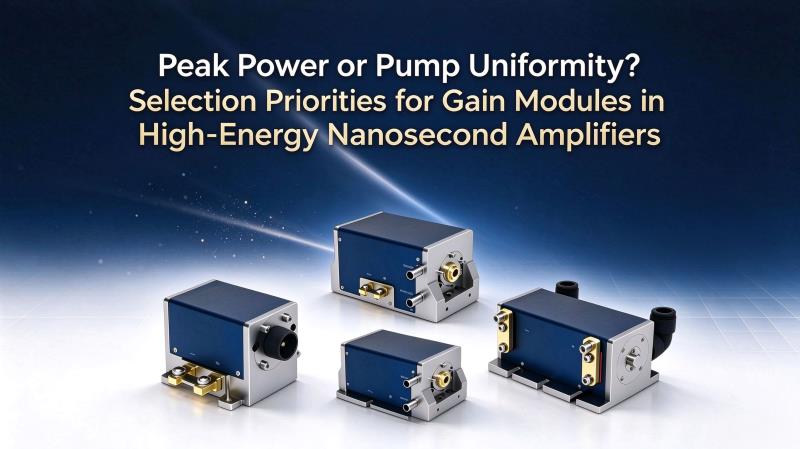
When selecting a gain module for a high-energy nanosecond laser, pump peak power is often the first parameter noticed. It is intuitive, easy to compare, and tempting to treat as“higher is better.”But in real amplification-chain design, peak power only answers how much energy the pump source can inject—pump uniformity determines whether that energy can be efficiently extracted, at what beam quality, and whether the system can run stably at the target repetition rate over time. Drawing on publicly available technical data for Lumispot’s DPL series gain modules, this article explains why pump uniformity deserves first scrutiny in high-energy nanosecond amplification.
1. Peak Power Is an Input Metric; Pump Uniformity Is Where Output Efficiency Begins
Pump peak power reflects the upper limit of how much energy the diode pump source can inject into the gain medium. But the core task of a nanosecond amplification stage is energy extraction, not mere injection. If pump light is unevenly distributed across the crystal cross-section, the central region reaches high gain first while peripheral regions lag, creating a gap between extractable energy and theoretical stored energy. In other words, no matter how high the peak power, uneven pump distribution caps effective stored energy—and the amplification stage’s extraction efficiency is constrained at the source.
2. Pump Uniformity Directly Determines Amplified Beam Quality
In an oscillator, the resonator provides some mode confinement. In an amplifier, the beam passes through the gain medium only once or a few times, and non-uniform gain distribution is directly imprinted onto the output beam’s wavefront and intensity profile. In multi-stage nanosecond amplification chains, non-uniformity from one stage is further amplified by subsequent stages, ultimately degrading M² and focusing capability.
3. Pump Uniformity Affects Thermal Distribution, Which Limits Usable Repetition Rate and Duty Cycle
Non-uniform pumping means non-uniform heat deposition, generating transverse temperature gradients inside the crystal that drive asymmetric thermal lensing, thermally induced birefringence, and self-focusing. For high-energy nanosecond amplification stages, these thermal effects directly cap the repetition rate and duty cycle at which the system can operate stably over time.
Lumispot technical materials note that under high-power operation, uneven pump energy distribution inside the gain medium can cause asymmetric thermal lens effects, complex self-focusing, degraded beam quality, and potential optical damage risk—significantly affecting output stability and long-term reliability. The duty cycle boundaries and repetition rate limits specified for QCW modules (up to 25% duty cycle) are therefore tied to thermal management capability, and thermal management begins with pump uniformity.
4. Lumispot’s Solution: How Pump Homogenization Is Implemented
To address these challenges, Lumispot integrates proprietary pump homogenization technology into its DPL series diode side-pumped gain modules. According to publicly available technical data, the solution achieves the following key specifications:
l Gain distribution uniformity exceeding 90%. Innovative pump homogenization technology achieves uniform energy distribution within the gain medium, effectively suppressing non-uniform thermal effects, thermal lens distortion, and self-focusing.
l High-power pump integration up to 80kW (QCW mode). A multi-dimensional side-pumping structure with high-density integrated packaging maintains gain uniformity while delivering high pump power.
l Maximum duty cycle up to 25%. Supports high repetition rate and high duty cycle operation for demanding industrial processing and high-energy laser applications.
l Optical-to-optical conversion efficiency exceeding 45%–50%. Full-chain optimization from semiconductor materials to chip structures and packaging improves pump efficiency while reducing system power consumption.
l Compatibility with multiple gain media. Supports Nd:YAG, Nd:YLF, Er:YAG, and Nd:YVO₄, with crystal diameters from Φ2mm to Φ25mm for flexible integration.
l Designed operational lifetime exceeding 20,000 hours. Hard solder bonding and advanced thermal management ensure long-term reliability under high-power, high-duty-cycle conditions.
These technical characteristics point to a single design logic: ensure pump energy enters the gain medium uniformly first, then pursue entering more energy. For high-energy nanosecond amplification stages, uniformity is the shared prerequisite for beam quality, thermal stability, and long-term reliability.
5. Selection Recommendations
When evaluating gain modules, consider parameters in this order:
First layer: Pump uniformity and gain distribution uniformity. This is the “can it work at all” question. Insufficient uniformity may prevent the amplification stage from meeting beam quality or stability requirements regardless of power.
Second layer: Thermal management capability and duty cycle/repetition rate boundaries. With uniformity established, confirm whether the module can run stably at the target repetition rate and duty cycle over time.
Third layer: Peak power and total stored energy. This is the “is it enough” question. Insufficient power can be addressed by stepping up to a higher-power model; insufficient uniformity often requires redesigning the pump coupling scheme.
Lumispot DPL series offers modules across both CW and QCW directions, from tens of watts to 80kW pump integration capability, with customization for power, repetition rate, pulse width, gain medium type, and crystal dimensions to match specific amplification-chain architectures.
- Peak power is an input metric; pump uniformity determines energy extraction efficiency and beam quality.
- Insufficient uniformity directly degrades M², and the effect accumulates across multi-stage amplification.
- Thermal distribution is governed by pump uniformity, which in turn limits usable repetition rate and duty cycle.
Lumispot pump homogenization achieves gain distribution uniformity above 90%, while supporting up to 80kW pump integration and 25% duty cycle.
Recommended selection order: uniformity → thermal boundaries → peak power.
Pump uniformity and peak power are not opposing considerations, but in high-energy nanosecond amplification, their order of scrutiny should not be reversed. Uniformity is the shared foundation for beam quality, thermal stability, and long-term reliability; peak power is the “is it enough” question that follows. Lumispot DPL series gain modules are designed around pump homogenization as the starting point, offering a complete pumping solution from uniformity to power for high-energy solid-state lasers.
Post time: Oct-10-2026


