
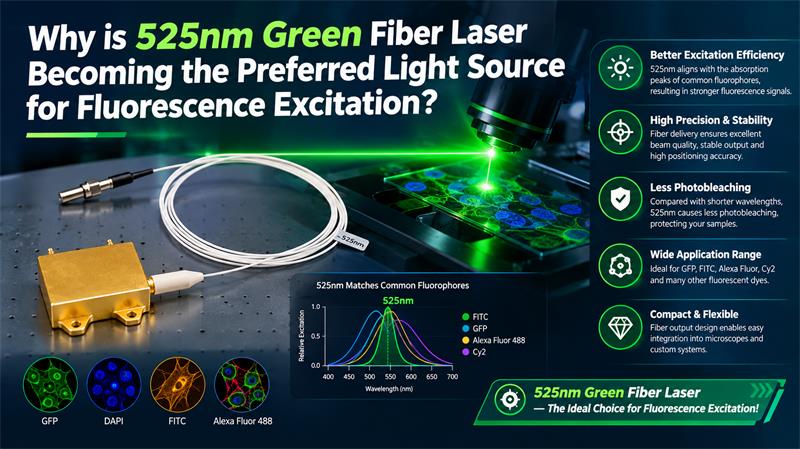
Fluorescence excitation is a common technical procedure in biomedical imaging, flow cytometry, spectral analysis and other fields. The selection of excitation light sources directly determines detection sensitivity and data quality. For a long time, broadband light sources such as mercury lamps and xenon lamps have dominated the market. However, their drawbacks including wide spectral lines, significant thermal effects and poor stability have become increasingly prominent. In recent years, 525nm green fiber lasers have emerged as the preferred light source for fluorescence excitation, thanks to their excellent monochromaticity, high power density and flexible fiber delivery capability. This article analyzes the technical logic behind this trend from the perspectives of light source technology evolution, spectral matching, signal-to-noise ratio improvement and system integration, and introduces Lumispot’s product portfolio of 525nm green fiber lasers.
I. Limitations of Traditional Broadband Light Sources: Why Upgrade Is Required
Conventional fluorescence spectroscopy commonly adopts mercury lamps, xenon lamps or deuterium lamps as excitation sources. These gas-discharge light sources suffer from disadvantages such as limited spectral lines, low luminous intensity, weak output in the ultraviolet band, poor stability and severe thermal effects. More importantly, before reaching the sample, light emitted by mercury lamps must pass through multi-stage optical filters and lenses, resulting in light attenuation of approximately one million times at the exit objective lens.
This means a large amount of energy is wasted on non-target wavelengths, leaving extremely low effective optical power to excite fluorescent molecules. In addition, mercury and xenon lamps generate substantial infrared thermal radiation during operation, which may cause thermal damage to temperature-sensitive biological samples. These limitations drive the evolution of fluorescence excitation light sources toward higher efficiency and lower thermal effects.
II. Core Advantages of Lasers as Fluorescence Excitation Sources
Lasers are used as light sources in laser-induced fluorescence spectroscopy. Lasers feature superior monochromaticity, narrow linewidth, good directionality, high intensity and strong coherence. A laser can excite more molecules in the target substance to the excited state, producing fluorescence with higher intensity than scattered light. Therefore, laser-induced fluorescence spectroscopy delivers higher detection sensitivity, better test performance, lower detection limits and facilitates analysis of structural composition and content of substances.
Compared with traditional sources such as mercury lamps, lasers also excel in service life. Lasers have a far longer lifespan than mercury lamps, xenon lamps or halogen lamps. In fluorescence excitation, the matching degree between the excitation wavelength and the absorption peak of fluorescent dyes directly governs excitation efficiency. Optimal performance can be achieved when the peak excitation wavelength of the dye is close to the laser wavelength. 525nm falls exactly within the optimal excitation range of many commonly used fluorescent dyes.
III. Unique Value of the 525nm Wavelength: Spectral Matching and Thermal Damage Control
The advantages of 525nm green light for fluorescence excitation lie first in its high efficiency to excite a wide range of fluorescent dyes. 525nm green light is well suited for exciting many valuable biological fluorescent probes, including Calcium Green, rhodamine derivatives and Cy3. In flow cytometry, 525nm green laser can excite popular fluorophores such as FITC, Alexa Fluor 488 and Qdot 525. Combined with fiber delivery, it can flexibly adapt to optical paths of instruments and improve the accuracy and efficiency of cell analysis.
Secondly, the 525nm laser contains no infrared thermal radiation components. Unlike gas-discharge sources such as mercury lamps, the spectral composition of a 525nm laser is completely free of infrared thermal rays, eliminating risks of sample denaturation caused by heating. This characteristic is especially critical for temperature-sensitive applications such as live-cell imaging and long-term fluorescence observation.
Moreover, 525nm green light boasts favorable penetration and specific absorption characteristics in biological tissues. Leveraging the strong absorption of 525nm green light by blood vessels, it enhances visualization of vascular patterns on mucosal surfaces and improves diagnostic accuracy.
IV. Fiber Coupling: More Flexible and Compact Fluorescence Excitation Systems
In traditional fluorescence microscopes, light sources require collimation, filtering and focusing via free-space optical components, leading to complicated optical paths and high alignment precision requirements. Fiber-coupled lasers deliver laser light directly into instrument optical paths through flexible optical fibers, greatly lowering the difficulty of system integration.
In fiber-optic fluorescence microscopes, no filters or lenses are needed along the fiber path, resulting in minimal radiant intensity loss. In contrast, for traditional mercury lamp solutions, light intensity is attenuated by roughly one million times from the mercury lamp to the exit objective. The benefits of fiber coupling extend beyond efficiency; it enables flexible system layout. Optical fibers can adapt to the spatial design of different equipment, allowing excitation sources to be integrated into flow cytometers, confocal microscopes, fluorescence endoscopes and various other instruments.
V. Lumispot 525nm Green Fiber Lasers: Product Solutions Built for Fluorescence Excitation
Lumispot has launched a series of 525nm fiber-coupled green lasers tailored for precision applications including fluorescence excitation.
Core Product Advantages
- · Excellent beam uniformity: Lumispot green lasers deliver outstanding beam uniformity and heat dissipation performance, ensuring even distribution of excitation light on samples and improving consistency of fluorescence signals.
- · Compact structural design: The laser head and control unit are integrated into one compact assembly for easy integration into diverse fluorescence detection equipment.
- · Wide environmental adaptability: It supports stable operation within 15℃ to 35℃, suitable for standard laboratory and clinical detection environments.
- · Long service life: Adopting semiconductor laser architecture, it features a much longer lifetime than traditional gas-discharge light sources.
- · Cellular fluorescence excitation and sorting in flow cytometry
- · Excitation light source for confocal microscopes
- · Excitation illumination in fluorescence endoscopic surgery
- · Spectral analysis and photoelectric detection
- · Neuronal stimulation in optogenetics
Typical Application Scenarios
As biomedical imaging, flow cytometry and precision spectral analysis continuously raise requirements for detection sensitivity and data quality, fluorescence excitation light sources are rapidly transitioning from traditional mercury lamps to semiconductor lasers. With precise spectral matching, heat-free excitation and flexible fiber delivery capability, 525nm green fiber lasers play a central role in this transition. Centered on its 525nm green fiber laser series, Lumispot delivers complete light source solutions for fluorescence excitation, covering low-power precision detection to high-power system integration.
Post time: Oct-16-2026


