
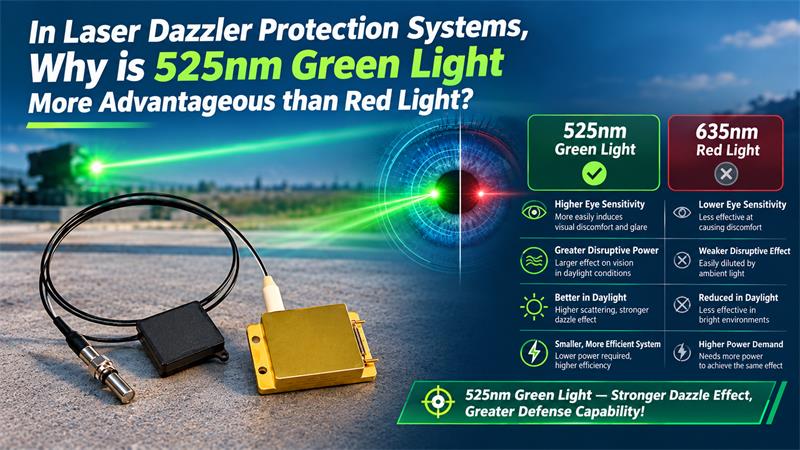
In the design of laser dazzler defense systems, wavelength selection is one of the core factors determining system performance. Red light and green light differ significantly in visual stimulation efficiency, atmospheric transmission performance and effective dazzling range. So how does 525nm green light become the preferred option for laser dazzler defense systems?
I. Human Eye Spectral Response: The Natural Advantages of Green Light
Human eyes show vastly different sensitivity to light of varying wavelengths. The cone cells and rod cells in the retina have different response efficiencies to photons of different wavelengths. Overall, human eyes are much more sensitive to green light than red or blue light. Studies show that under identical optical power, human eyes are over 5 times more sensitive to green light than red or blue light under daytime photopic vision conditions.
From the spectral response curve, the peak sensitive wavelength of human eyes for daytime photopic vision is around 555nm, while the peak shifts to approximately 505nm (blue-green band) under night scotopic vision. The 525nm green light falls exactly within the “golden range” between these two peaks, maintaining high visual stimulation efficiency both in daylight and twilight. This means that to achieve the same dazzling effect, 525nm green laser requires far lower power than red light, improving system performance while reducing power consumption and thermal management burdens.
More importantly, research indicates that green light can interfere with the human eye’s target tracking capability more effectively than red light. Under low-light conditions such as dawn and dusk, relatively low-energy green laser can produce remarkable degradation of visual performance.
II. Atmospheric Transmission and Scattering: Visibility Advantages of Green Light
The effective range of a laser dazzler system depends not only on the laser’s own power but also on beam transmission performance in the atmosphere. The scattering characteristics of green light in the atmosphere endow it with unique advantages in visual perception. Thanks to the high sensitivity of human eyes to green light, green laser of the same power delivers significantly higher visual brightness and spot visibility in the atmosphere compared with red laser.
Lumispot’s laser dazzler operates at 525nm±5nm, with an average output power ≥4W at 25℃, and an effective working range covering 20m to 200m. Equipped with IP65 protection rating and intelligent spot adjustment function, it can adapt to various harsh environmental conditions. Benefiting from the high visibility of green light, this product can deliver effective warning and dazzling effects with lower power in scenarios including perimeter security, border defense and area denial.
III. Technical Maturity: Route Differences Between 525nm and 532nm
Currently, commercially available green laser dazzlers mainly adopt two wavelengths: 525nm and 532nm. Although both fall within the green light spectrum, they have obvious differences in technical implementation paths and environmental adaptability.
The 532nm green laser usually adopts a DPSS (Diode-Pumped Solid-State Laser) scheme, which generates green light by frequency doubling 1064nm infrared light through nonlinear crystals. This technical route has inherent limitations: crystals are sensitive to temperature changes, leading to fixed output wavelength with poor adjustability. Such devices are difficult to start at low temperatures, and frequency doubling efficiency decreases under high-temperature conditions.
In contrast, 525nm green light can be directly generated by semiconductor lasers without frequency doubling crystals. As a result, 525nm laser dazzlers feature much better environmental temperature adaptability than 532nm solutions. Specifically, the semiconductor scheme supports stable operation over a wide temperature range from -20℃ to +60℃. Meanwhile, semiconductor laser solutions offer smaller size, higher electro-optic conversion efficiency and longer service life.
IV. Non-Lethality and Safety Compliance
The core design principle of laser dazzlers is to suppress targets effectively without causing permanent injury. Lumispot’s laser dazzler systems are designed in strict accordance with international specifications for non-lethal optical jammers. All laser dazzler devices are engineered to ensure the working energy is well below the Maximum Permissible Exposure (MPE), achieving effective dazzling effects while minimizing safety risks. The selection of the 525nm green wavelength enables better dazzling performance under the same safety margin and further enhances the non-lethal safety characteristics of the system.
The advantages of 525nm green light applied in laser dazzler defense systems come from the combined effects of human eye physiological characteristics, atmospheric transmission performance and mature semiconductor laser technology. With the growing demand for non-lethal defense, green laser dazzler technology is advancing toward higher power, longer range and stronger environmental adaptability. Taking 525nm fiber-coupled green lasers and laser dazzler systems as core products, Lumispot continues to provide stable and reliable non-lethal defense solutions for security, border defense and military applications.
Post time: Oct-16-2026


